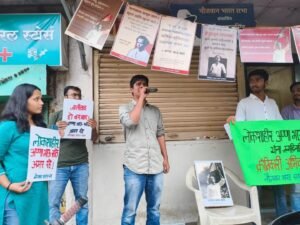
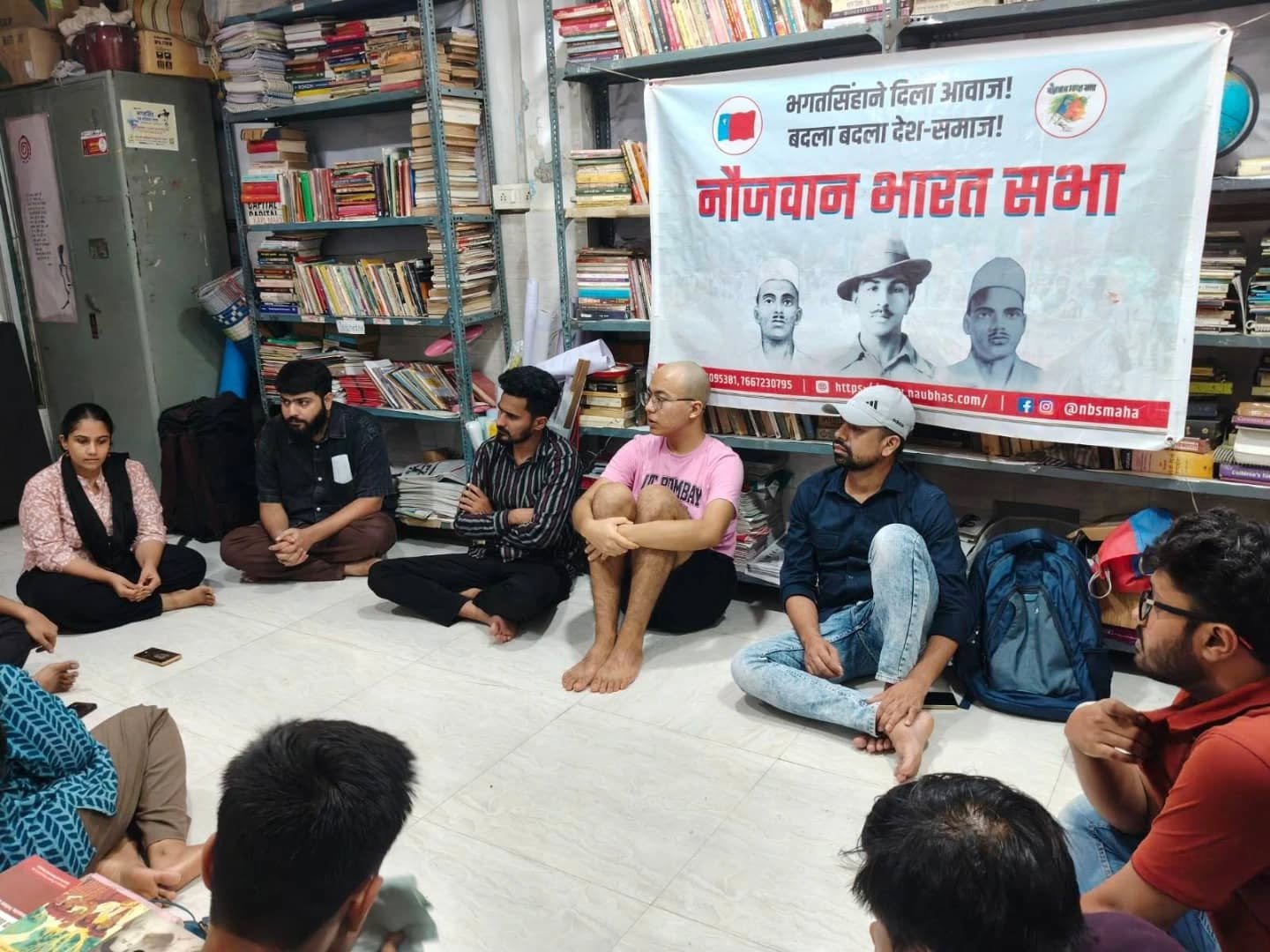
The event was an initiative by law students associated with the organisation and aimed at critically examining the state of the judiciary, both historically and in contemporary times.
The discussion began with an elaboration on why it is important to look at the judiciary with a critical eye. It was pointed out that the liberal celebration of the Constitution often hides the fact that the Constitution itself has contradictions that allow for human rights to be violated. The first half of the session was spent examining the scope of the Constitution and discussing how these contradictions came to be. This part of the discussion focused on the Constituent Assembly, its composition, and the different ideas of freedom held by the ruling class and the common people in colonial India. It was argued that the Constitution worked as a tool for the ruling class to establish itself as the authority. The ruling class at that time wanted to crush any radical potential in the people, and the Constitution was made to limit this potential. The crushing of rebellions like the Telangana and Tebhaga uprisings and the naval mutiny were discussed as examples of state repression. The ADM Jabalpur vs Shivkant Shukla case was also mentioned, where the writ petition of habeas corpus was cancelled by the Congress government during the Emergency, showing that the Congress was no friend of the people.
We then shifted the discussion to contemporary times. It was pointed out that the bourgeois parliamentary system today is hollow and lacks any democratic content, which has allowed fascism to grow and permeate society. The Prime Minister visiting the Chief Justice of India’s house to celebrate Ganesh Chaturthi, and High Court and Supreme Court judges attending VHP events and making openly communal remarks, are clear examples of the increasing closeness between the Executive and the Judiciary. The talk also focused on the current Home Minister’s involvement in the Sohrabuddin Sheikh encounter case and the current government’s involvement in the suspicious death of Justice Loya. Preventive detention and terrorism laws like TADA and UAPA were also discussed, showing how these laws are used to suppress political activists. Cases of political repression, such as those of Umar Khalid and the Bhima Koregaon accused, were highlighted. We talked about the executive’s interference in the appointment of judges, especially their attempt to form the NJAC, which was declared unconstitutional. The discussion also touched upon how fascist forces have tried to infiltrate the judiciary and, in many ways, have already succeeded.
Discussions ranged from the recent arrest of journalist Rejaz to the rustication of a 19-year-old student from Pune for a Facebook post, and even the undemocratic investigation against Professor Mahmudabad of Ashoka University. The extra judicial killings and unconstitutional cremations of political activists in tribal areas by the Indian state was also mentioned as an example of how the state does not respect even basic human dignity. The open corruption at the lower levels of the judiciary and how money influences decisions were discussed. The sham of legal equality and the so-called rule of law were discussed at length.
The discussion ended by stressing the need to understand the true state of the judiciary, who it serves, and what we can do about it. It was emphasized that we must unite the idea of true justice with the power of the people. That we must protect our democratic and civil liberties by fighting in the courts whenever possible, but we should not stop there. The group collectively agreed that students of law are also responsible for organizing people, asking questions, and holding the fascist government and the ruling class accountable.